


Incorporate a US C-Corp Online





















Built for Founders

Non-US Residents

AI Startups

Crypto & Web3

Raising a Round
Choose Your State
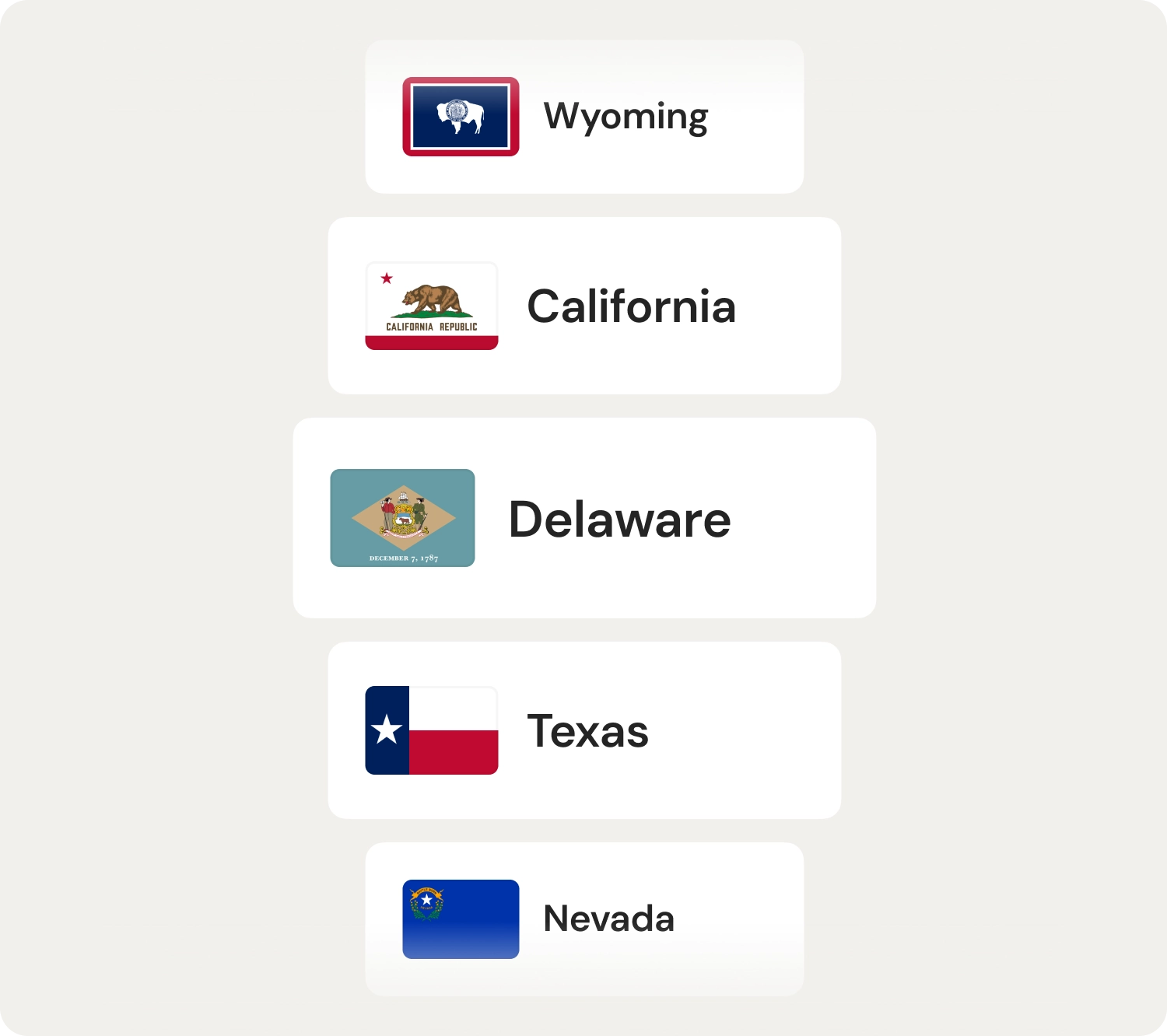
Delaware

The default for venture-backed startups. Over 60% of Fortune 500 companies are Delaware C-Corps.
Wyoming

Budget-friendly alternative to Delaware, minimal annual fees.
Texas

Zero state costs until you’re making real money. Tech giants like Tesla, Oracle, and Hewlett-Packard have relocated here.
California

The most expensive option, but required if you have employees,
an office, or significant sales in CA.
Nevada

Nevada doesn't share corporate data with the IRS or disclose shareholders publicly. No corporate income tax.
How Long Does It Take?

and more on your dashboard.
Launch Your US C-Corp with Skala

on business days


on business days
on business days
on business days
on business days
Launching a C-Corp: Skala vs Other Platforms




($990 for NV)


Keep Your Company Compliant After 1st Year
What it costs to keep your C-Corp running with Skala — no surprises.
Registered Agent

An individual or third-party service designated by a US business to receive official legal and government correspondence on its behalf.
NY Mailing Address
A physical US address that collects your mail, from client letters to your bank card.
Franchise Tax Filing
A state taxfor the right to exist as a legal entity and to do business within Delaware.
$199 Skala fee + $450 State fee.
Registered Agent
An individual or third-party service designated by a US business to receive official legal and government correspondence on its behalf.
NY Mailing Address
A physical US address that collects your mail, from client letters to your bank card.
Statement of Information
Report key business details to the Secretary of State.
$199 Skala fee + $25 State fee.
Registered Agent
An individual or third-party service designated by a US business to receive official legal and government correspondence on its behalf.
NY Mailing Address
A physical US address that collects your mail, from client letters to your bank card.
Annual Report
Report key business details to the Secretary of State.
$199 Skala Fee + $60 State Fees
Registered Agent
An individual or third-party service designated by a US business to receive official legal and government correspondence on its behalf.
NY Mailing Address
A physical US address that collects your mail, from client letters to your bank card.
Public Information Report
Report key business details to the Secretary of State. $199 Skala Fee.
Registered Agent
An individual or third-party service designated by a US business to receive official legal and government correspondence on its behalf.
NY Mailing Address
A physical US address that collects your mail, from client letters to your bank card.
Annual List & Business License
Report key business details to the Secretary of State.
$199 Skala fee + $650 State fee.
Grow and Protect Your Company
Already on Skala? These services are one click away in your dashboard.

Certificate of Good Standing

Trademark Registration

More Jurisdictions
What Our Founders Say

Legal tasks were always a distraction and something we'd put off until they became urgent. Now with Skala, everything runs seamlessly in the background, so we can focus on what actually matters.


Choosing the right jurisdiction for a startup is still a challenge. Skala provides much-needed clarity in this process.


We used Skala for our seed fundraising and had a great experience. The platform offers a variety of fundraising instruments and provides flexibility in structuring investment rounds.


Skala is building the much-needed legal infrastructure for the crypto economy. We use their platform to manage our entities and access experienced crypto lawyers.


Featured Posts


Why Every U.S. Company Needs a Registered Agent


LLC vs. C-Corp – Which Is Right for Your Business?

What Is the Delaware Flip and When Does Your Business Need It?
How to Convert from an LLC to a C-Corp
When Should I Incorporate My Startup?
Post-Incorporation Checklist for U.S.-Based Startups
Pre-Incorporation Checklist for U.S.-Based Startups

FAQ
Just the three docs:
- Your ID / Passport
- Proof of Address
- Proof of Residence
We will handle everything else for you.
No, the company formation and bank account opening process can be completed entirely online by citizens or residents of any country, except those permanently residing in sanctioned jurisdictions.
(1) Certificate of Incorporation — a document filed with the State of Delaware that evidences the formation of your C-corporation.
(2) Bylaws — the internal governing document for your C-corporation, which outlines the powers and duties of the stockholders, directors, and officers.
(3) Initial Board Resolutions — the document commonly used for initial stock distribution, officer election, and setting up the company's operations.
(4) Founder Stock Purchase Agreement — an agreement under which the founder assigns his intellectual property to the company in exchange for the company’s shares. Comes in two versions – with or without vesting.
(5) Proprietary Information and Invention Assignment Agreement — an agreement by which founders, employees, advisors, and others assign to the company the intellectual property and other proprietary rights they create while performing work for the company.
(6) Capitalization Table — a spreadsheet that lists all stockholders of the company, the number of shares they hold, and their ownership percentages.
(7) Statement of Incorporator — a document that appoints the initial directors of the C-corporation.
(8) EIN Notice — an official letter from the IRS assigning your company an Employer Identification Number.
(9) Beneficial Ownership Information Report — a document required by the Corporate Transparency Act that identifies the individuals who own or control a company, helping to prevent money laundering and other illicit activities.
Yes, one person can hold all the positions in the company. This person can even make an agreement between the company and himself as an individual.
It depends on your state, entity type, and revenue — but for most early-stage founders, expect roughly $1,500–$2,500 per year in total.
Here's what that includes:
- Registered agent (~$160–$200/yr) — required by law. A designated service that receives official legal and government correspondence on your company's behalf. Included in your first year with Skala.
- US mailing address (~$250/yr) — not a legal requirement, but most banks need a physical US address on file to open and maintain your account. Also included in your first year.
- Annual state filing ($0–$849/yr) — required by law, but the name and cost vary by state. Delaware calls it a Franchise Tax Filing, California a Statement of Information, Wyoming an Annual Report, Texas a Public Information Report, Nevada an Annual List & Business License. Skala can handle the filing for $99+ on top of the state fee.
- Accounting & bookkeeping (~$1,500/yr) — you'll need your own. Less for a simple LLC, more for a C-Corp with cross-border activity.
- Federal corporate income tax (21%) — though most early-stage startups pay nothing here because they're not yet profitable.
Converting an LLC to a C-Corp is common — many founders start with an LLC for simplicity and convert when they're ready to raise venture capital. The process varies by state but generally involves either a statutory conversion (filing a certificate of conversion with the state) or a statutory merger (merging the LLC into a newly formed C-Corp).
There are a few things to watch for. The conversion may trigger a taxable event depending on how your LLC assets are valued at the time of conversion. You'll also need to draft entirely new corporate documents — bylaws, board resolutions, stock purchase agreements — since the governance structure changes completely. And any contracts or bank accounts tied to the LLC will need to be transferred. It's doable, but it costs time and legal fees, so if you already know you'll raise institutional capital, incorporating as a C-Corp from the start is usually cheaper. For a step-by-step walkthrough, see our guide.
Launch Your Business with Confidence
Start for Free with Skala

Migrate it to Skala for maintenance

We will notify you of important deadlines

Impress your investors and get money fast

Import your actual and pending trademarks free of charge

Quickly generate NDAs, onboard contractors without hustle

We will help you with getting a bank account

Legal quizzes and guides

Access special offers and perks from our partners

If you need one, we'll get you introduced in no time
