The annual maintenance costs may vary depending on your particular business operations. However, the usual annual cost breakdown is as follows:
(1) Certificate of Formation — a document filed with the State of Delaware that evidences the formation of your LLC.
(2) LLC Operating Agreement — the charter document of the LLC that outlines the company's ownership structure and members’ duties. An operating agreement is suitable for both single-member and multiple-member LLCs.
(3) Statement of Authorized Person — a document that names the initial members of the LLC.
(4) EIN Notice — an official letter from the IRS assigning your company an Employer Identification Number.
(5) Beneficial Ownership Information Report — a document required by the Corporate Transparency Act that identifies the individuals who own or control a company, helping to prevent money laundering and other illicit activities.
No, the company formation and bank account opening process can be completed entirely online by citizens or residents of any country, except those permanently residing in sanctioned jurisdictions.
LLCs are usually managed by either the members directly or by appointed managers. In a member-managed LLC, all members have authority to make decisions and manage day-to-day operations. In a manager-managed LLC, members appoint one or more managers to handle operations, while the members retain ownership but may not be involved in daily management.
We’ll help you file a bank account application with Mercury, Brex, Relay, and Wise.

This affects your annual fees, taxes, and privacy. If you're not sure what you need, book a 15-min free consultation with our lawyer.
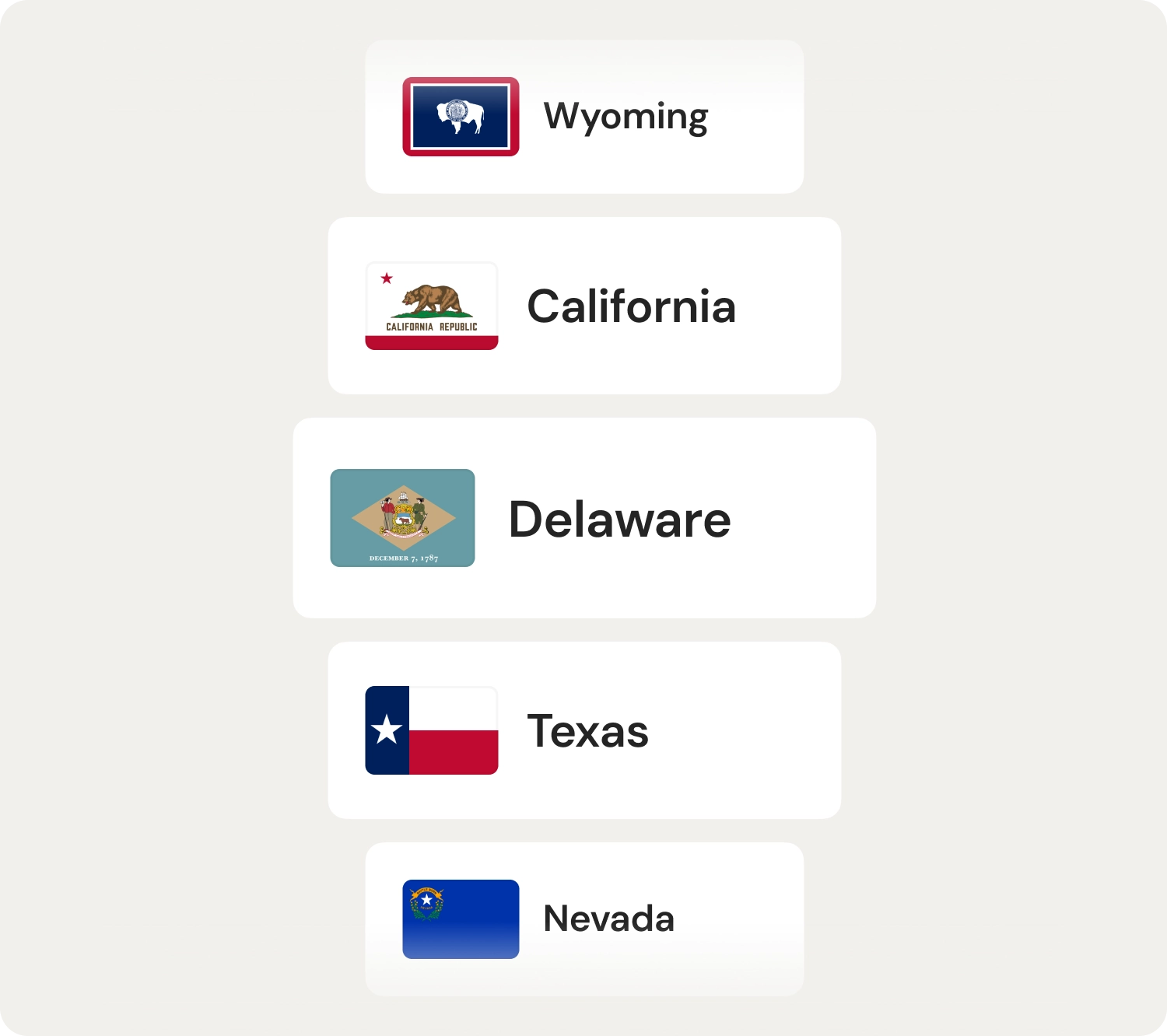
The most battle-tested LLC law in the US — 230+ years of business-court case law, so the rules are clear if anything's ever disputed.
Budget-friendly alternative to Delaware, minimal annual fees.
Zero state costs until you’re making real money. Tech giants like Tesla, Oracle, and Hewlett-Packard have relocated here.
The most expensive option, but required if you have employees,
an office, or significant sales in CA.
Nevada doesn't share corporate data with the IRS or disclose shareholders publicly. No corporate income tax.
What it costs to keep your LLC running with Skala — no surprises.
Already on Skala? These services are one click away in your dashboard.
Legal tasks were always a distraction and something we'd put off until they became urgent. Now with Skala, everything runs seamlessly in the background, so we can focus on what actually matters.
Choosing the right jurisdiction for a startup is still a challenge. Skala provides much-needed clarity in this process.
We used Skala for our seed fundraising and had a great experience. The platform offers a variety of fundraising instruments and provides flexibility in structuring investment rounds.
We use Skala for both company management and trademark applications. I just like that everything is in one place.
Just the three docs:
We will handle everything else for you.
No, the company formation and bank account opening process can be completed entirely online by citizens or residents of any country, except those permanently residing in sanctioned jurisdictions.
(1) Certificate of Incorporation — a document filed with the State of Delaware that evidences the formation of your C-corporation.
(2) Bylaws — the internal governing document for your C-corporation, which outlines the powers and duties of the stockholders, directors, and officers.
(3) Initial Board Resolutions — the document commonly used for initial stock distribution, officer election, and setting up the company's operations.
(4) Founder Stock Purchase Agreement — an agreement under which the founder assigns his intellectual property to the company in exchange for the company’s shares. Comes in two versions – with or without vesting.
(5) Proprietary Information and Invention Assignment Agreement — an agreement by which founders, employees, advisors, and others assign to the company the intellectual property and other proprietary rights they create while performing work for the company.
(6) Capitalization Table — a spreadsheet that lists all stockholders of the company, the number of shares they hold, and their ownership percentages.
(7) Statement of Incorporator — a document that appoints the initial directors of the C-corporation.
(8) EIN Notice — an official letter from the IRS assigning your company an Employer Identification Number.
(9) Beneficial Ownership Information Report — a document required by the Corporate Transparency Act that identifies the individuals who own or control a company, helping to prevent money laundering and other illicit activities.
Yes, one person can hold all the positions in the company. This person can even make an agreement between the company and himself as an individual.
It depends on your state, entity type, and revenue — but for most early-stage founders, expect roughly $1,500–$2,500 per year in total.
Here's what that includes:
Converting an LLC to a C-Corp is common — many founders start with an LLC for simplicity and convert when they're ready to raise venture capital. The process varies by state but generally involves either a statutory conversion (filing a certificate of conversion with the state) or a statutory merger (merging the LLC into a newly formed C-Corp).
There are a few things to watch for. The conversion may trigger a taxable event depending on how your LLC assets are valued at the time of conversion. You'll also need to draft entirely new corporate documents — bylaws, board resolutions, stock purchase agreements — since the governance structure changes completely. And any contracts or bank accounts tied to the LLC will need to be transferred. It's doable, but it costs time and legal fees, so if you already know you'll raise institutional capital, incorporating as a C-Corp from the start is usually cheaper. For a step-by-step walkthrough, see our guide.